March 12/2020 Reading Response

Smithsonian Core Strategy Statement
Produce and curate content that appeals to individuals who value education and are interested in engaging with our various institutions, which will always strive to provide them with accurate information.
Messaging Framework
First Impression: Hope the audience feels the company is professional, unbiased, and dedicated to posting accurate information.
Value Statement: We provide materials that seek to educate people of all audiences.
Proof: Content can be easily fact checked and contains links to more information to backup its claims (National Archives for example).
3/5/2020 Reading Response
Smithsonian Core Strategy Statement
Produce and curate content that appeals to individuals who value education and are interested in engaging with our various institutions, which will always strive to provide them with accurate information.
Notes
According to Meghan Casey’s Content Strategy Toolkit, every core strategy statement needs to advertise the content the organization produces, address the audience they wish to appeal to, mention user needs, and the business goals that will come result from people engaging with their posts.
I feel that my statement achieves all of Casey’s requirements. I address how the content is based in education and history. I mention that this will naturally appeal to people who are interested in that. I mention how users will rely on the Smithsonian to provide them with information and trust the information is accurate, which falls under user needs. Finally, I address how the ultimate goal of the social media campaign is to hope users will visit the museums to further their education.
2/27/2020 Reading Response
Posted on the website Sprout Social, Chloe West illustrates valuable marketing tactics in “6 Standout Social Media Marketing Examples to Inspire Your Strategy”. Her third strategy comes from the mattress company Casper. They use “cross-channel marketing” to reach an audience on multiple platforms. Embedded in their Instagram post about their new “Sleep Channel” were links to access the material on Spotify and YouTube.
This strategy makes it very accessible to people that do not want to waste time searching for the content. Users are more likely to engage with the content when it is made easily available to them.
I believe this is a strategy the Smithsonian could use on their Instagram. Sometimes the content on their Facebook and Instagram have the same or similar image, but the caption is different.
The Facebook captions are longer, better written, and contain links to more information on the topic.
Their Instagram captions are shorter and use emojis and hashtags to capture people’s attention. This is a good strategy for Instagram, as I argue in my rhetorical analysis that Instagram posts should have shorter captions and focus on the visual side of the content. However, if people would like to learn more information on the subject, links to their Facebook page would increase engagement and (if user enjoys the content on both platforms) circulation.
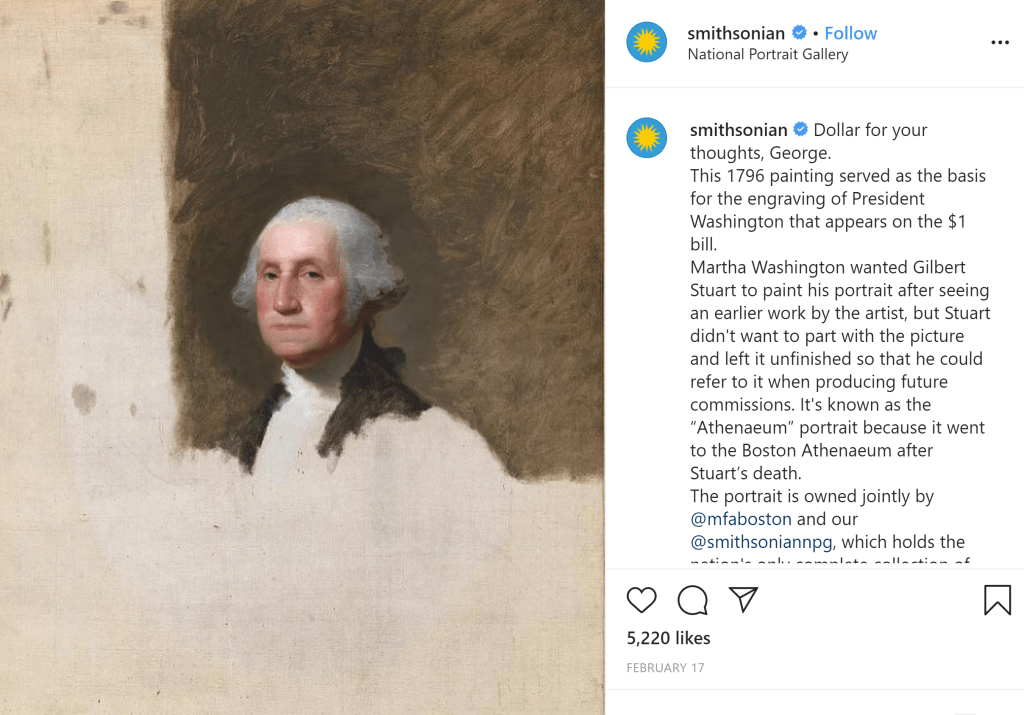
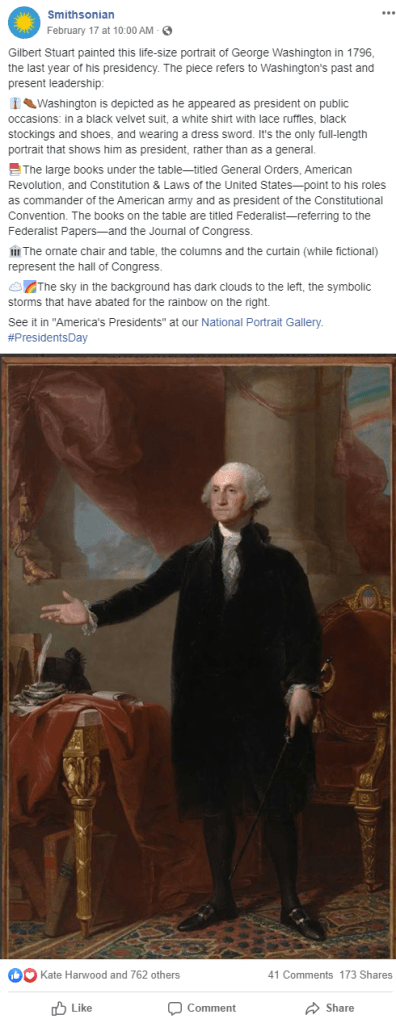
Here are two examples of content on different platforms that were posted on the same day and pertain to the same subject. The Instagram post’s caption should be shorted, as I have to scroll too much, and contain a link to their Facebook post.
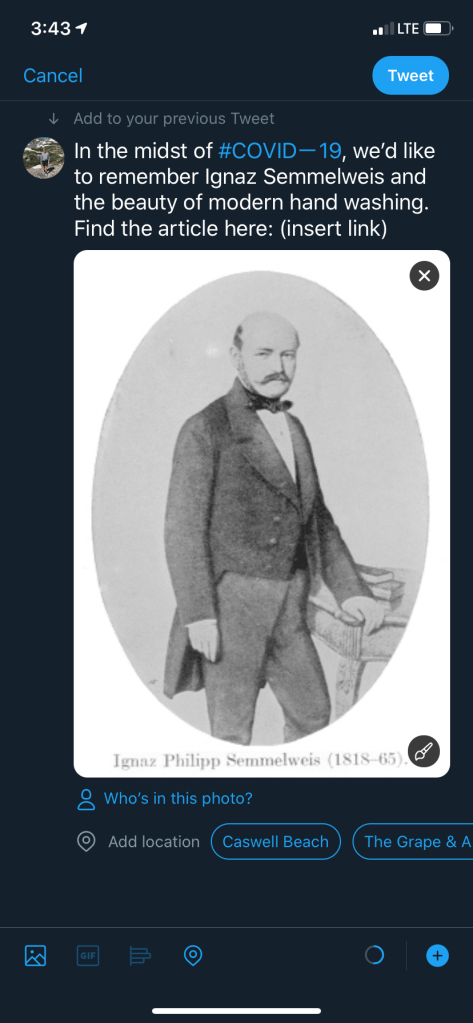
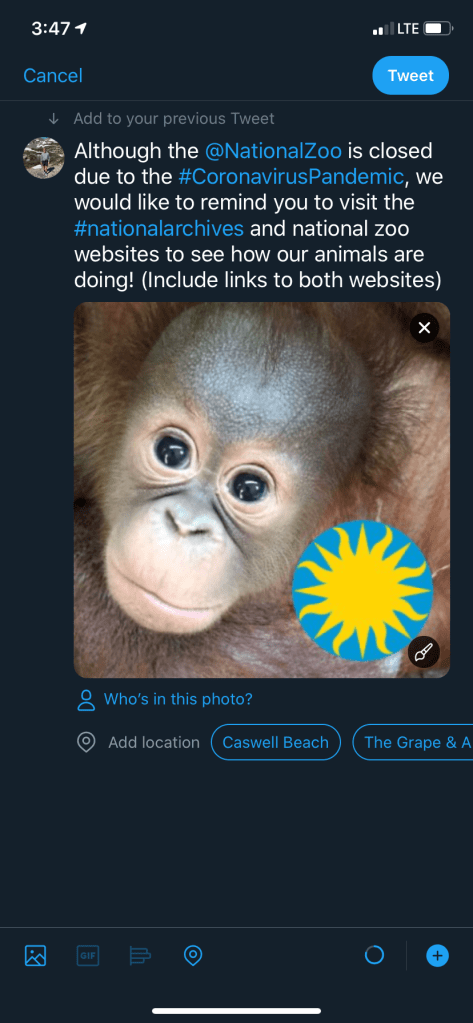
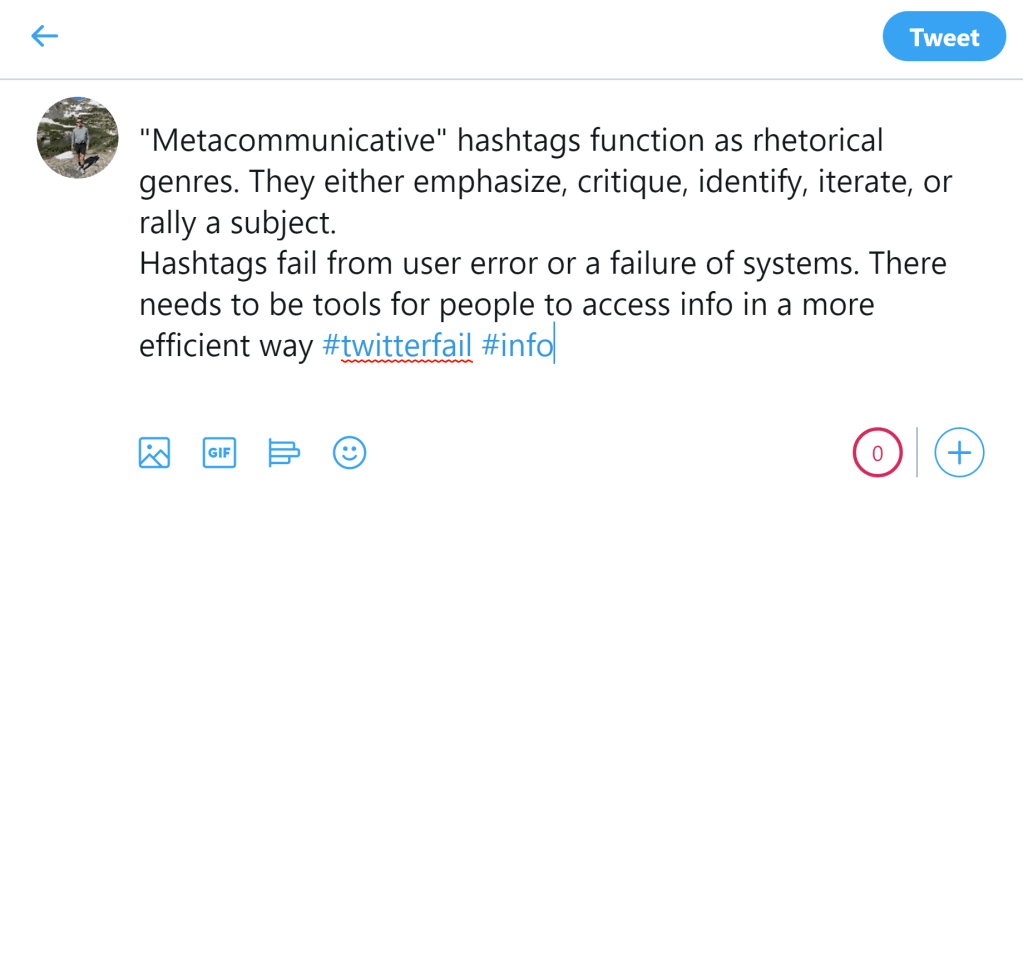
2/18/2020 Reading Response: Twitter Format
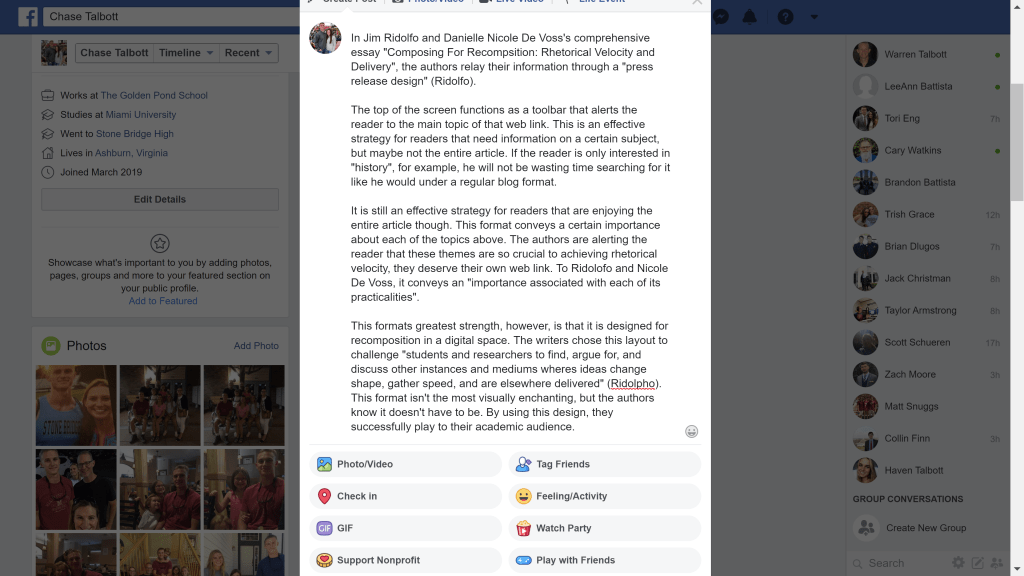
2/11/2020 ENG 224 Reading Response: Facebook Screenshot
ENG 224 2/5/2020 READING RESPONSE
At the conclusion of “Composing with Rhetorical Velocity” the authors provide questions that rhetors must consider when aiming for rhetorical velocity.
First, the rhetor needs to decide where his text is going. This applies to our rhetorical analysis, because finding the right platform for an organization’s posts is crucial. Each student also has to contemplate whether certain platforms might cause issues for their content. If a problem arises, the student needs to pick another platform or alter their media.
Then, the content organizer needs to identify what factors best circulate content. It might rely on people retweeting, sharing, and liking the post or non-human factors could be at play. The creator needs to find which factors give them the best chance for rhetorical velocity and adjust their content accordingly.
It is also important for the creator to protect himself. The creator needs to think risks that could arise from the content. Maybe their is offensive content in the post that would backfire on the organization and, therefore, needs to be removed.
Justified or not, people may share negative comments about the post online. In the rhetorical analysis, each student needs to find strategies to limit this from happening. The creator should not give someone a reason to ruin their chances at rhetorical velocity.
Wysocki’s approach focuses on the content on the screen and how to guide the readers attention. The strategies above focus on how to deliver content. In light of current social media practices, however, the authors fail to acknowledge how common it is for others to alter original content.
In the authors eighth chapter “Case Study: The D Brand”, the authors analyze a Detroit campaign’s objectives to positively influence the public’s perception of Detroit city. The authors main argument is not to endorse D Brand, but to analyze whether it’s strategies would be applicable in the classroom and in public rhetoric. They focus on kairotic coordination, which can create moments of great accomplishment and lead to others success in the future. Most importantly, the authors are interested in finding a model for public rhetoric that pays attention to “the broad arc of circulation, including the way compositions are produced, reproduced” (Anthony) and etc.
2/4/2020 ENG 224 Reading Response
In Anne Wysocki’s fifth chapter of The Multiple Media of Texts, she provides three elements for analyzing the visual aspects of texts: name the visual elements, name the designed relationship among those elements, consider how those elements connect with different audiences, contexts, and arguments. The visual aesthetics of a social media post are crucial for its success. Therefore, someone that is analyzing a post that can only name poor visual elements, typically won’t bother to analyze its other parts. This also plays into how those elements connect with each other to create a visually appealing post. There can be certain parts of a post that are excellent, but fail to complement other parts of it. Finally, the analyst has to contextualize the information and imagine what the designers intended to convey to the audience. A designer can produce great material, but without a target audience it means nothing.
She ends her chapter by illustrating the importance of analyzing content. She explains that rhetoric, entertainment, and visual configuration is not just for an audience’s entertainment, but is “of particular use when they help us see how we have become and continue to be who we are” (Wysocki). She wants to show to her audience that this content is more than someone trying to gain popularity. It is a reflection on a societies interest, values, humor, etc. Analyzing this material can help us gain a better understanding of what makes people happy, what makes them sad, and how to educate an audience on important issues.
In Cristina Tardagulia’s article on spotting fake images on the internet, she provides the audience with questions to consider when looking at an image. Most of them relate to when the image was taken and why it is showing up now. She gives us three tools that can answer those questions: google reverse image search, TinEye, and Yandex. In today’s cycle of fake news, as she mentions “military conflicts that are usually surrounded by false images” (Tardagulia) as inspiration for her article, it is especially crucial to consider using these websites.
1/30 ENG 224 Reading Response
In Gillespie’s piece, “Platforms Intervene”, he argues that social media platforms contort public opinion by deleting and suspending certain information. This key word platform, which he uses to address the social media corporations that allow for public debate, is central to his article. These platforms not only censor oppositional viewpoints, but they promote others. This has a tremendous impact on what the an average social media user sees or has the ability to see. If people are presented a viewpoint that isn’t challenged by another, they are bound to believe, write, and circulate that bias throughout the rest of the platform. He is aware that the internet is home to thousands of platforms where individuals can find controversial content and that social media sites are private companies that have the ability to regulate their content. However, he argues that when a platform becomes so popular that people expect to see certain content, there needs to be different expectations for encouraging diversity of thought. He ends the article with “platforms intervene, and the public culture that emerges from them is, in important ways, the outcome” (Gillespie). Clearly the role that social media platforms play in our culture is tremendous and is worthy of concern.
In Ball’s excerpt from Naming What We Know: Threshold Concepts of Writing Studies, she argues that all writing is multimodal. There are five modes that create meanings in language and all texts create these modes, making all writing multimodal. Historically speaking, mode has a different definition, but in multimodal theory it relates to distributing “equal emphasis on how meanings are created… and circulated through choices in design… and interpretive senses” (Ball). She addresses multimodal theory because of two common misconceptions: all multimodal writing is digital and the belief in monomodal text. She dismisses these claims by returning to her argument on all writing being multimodal and references examples of text that have no relationship to technology.
 ENG/IMS 224 C